The Nature of Good and Evil
AI FREE ZONE
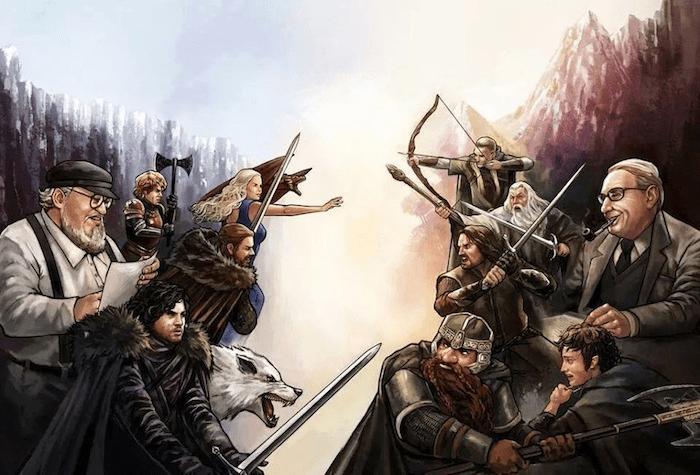
J.R.R Tolkien is considered the grandfather of fantasy writing in the modern era. His books are legendary works of fantasy fiction, from the highly regarded epic trilogy ‘The Lord of the Rings’, to his children’s story ‘The Hobbit’. His world is extensive in history and has its foundations firmly moulded by Christian theology and teachings.
George R.R. Martin on the other hand has redefined fantasy and real historical politics and systems of governance. His books include, magic, mythical beast and other fantastic mythos, but it far more grounded in medieval realism and culture. His messages are not found purely in religious teaching, rather in historical observations.
On the surface there are similarities in their approach to many things in the fantasy world. Both have the impending calamity of a dark and sinister force, both have factions within their worlds that have cultural and religious differences, both have unlikely hero’s and journeys of great peril. Underneath these similarities is a fundamental difference that separates the core message.
Put simply, is there good and evil, and how does it manifest itself in the world we live in?
Tolkien depict evil and goodness as an inherently pure commodity, something that it and will be until it isn’t. There are some exemptions to this narrative, but they are easily explained by some debate.
Meanwhile, Martin see’s evil and goodness as a gray area of a persons nature and nurture. Again, there are some exceptions through the books and his story, but his tales predominantly feature gray characters.
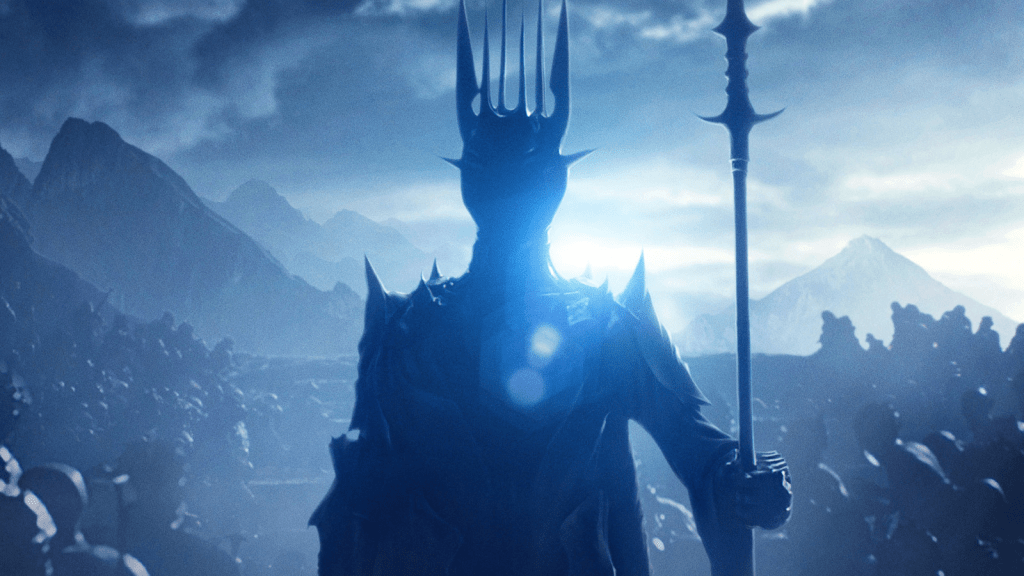
Tolkien, in my opinion depicts evil as a physical force that poisons the world around it much like an invasive species. Take Sauron, the evil dark lord, a trickster and manipulator whom can not create only mimic what is already good. His plan to dominate middle earth is inherently evil, to enslave middle earth and bring it into a new age of darkness. Is there are redeeming qualities to Sauron’s plan? no, I can’t think of a single quality that benefits the races of middle earth, nor the nature that surrounds it.
Sauron is a industrial giant that leaves everything in darkness and ash. He is a very one dimensional character, with one goal, moral outlook and corrupted by power.
Now lets take the good guys. Sam, Merry and Pippin. Three innocent, loving, brave but unlikely hero’s from the shire. They are not wanting for power, glory or heroic deeds, merely to live in peace. Besides some tom foolery, there is no bad in these people, no mention of jealousy, malice or hatred. They are the encapsulation of Devonshire people.
I suppose you could argue that Gollum is the closest thing Tolkien has to a gray character. Yet he is not. He is evil, and he is good, he is not gray. As Gollum he is a trickster, and Sméagol he is weak, and scared. His split personality resembles that there is both good and evil in us, but according to Tolkien’s literature we can only be one at a time.
An argument can be made in Sauron’s favour, that perhaps he was righteous in his endeavours. Perhaps he could see beyond the worship of a singular deity, that power does not belong to Eru Ilúvatar alone. Why should we bow to his majesty and glory? Should there not be free will amongst mortals and demi-gods alike?

Meanwhile George R.R. Martin gravitates towards characters being both good and evil, light and dark, while being singular. I struggle to think of a single character in Game of Thrones that is inherently good, why? Because they never find themselves in situations that are as one dimensional at Sam and Gandalf. While there is the threat of the Night King, and the zombies of the North, the threats in Westeros are boiled down to politics and house supremacy.
Let’s take an ‘evil’ character from the world of ‘A Song of Ice and Fire’ and look into their qualities.
King Joffrey Baratheon (Lannister), is known as being one of the darkest characters in fiction. A sadistic, arrogant, violent boy who tortures and humiliates his subjects for his own entertainment. While it is undeniable that he is inherently ‘evil’ Joffrey has some redeeming qualities.
Joffrey has the most dangerous job in Westeros, not only is he the King of a warring land with 9 kingdoms. He is a boy. His attributes are linked to his lack of wisdom, anxiety over his life and the lack of training for the job role before him. He is neither cunning, or intelligent, a statesman or warrior. He is a boy, trapped in the role of King while massively unqualified.
Joffrey has a few redeeming qualities. He is quick to anger, and sadistic. He is also a King of action, and takes little pleasure in wasting time. While others are overly cautious and subtle in plotting, he is a boy of conviction. Law is upheld through fear, and he is suspicious of everyone.
Now, the grayest character in Martins works is Jamie Lannister. A knight, a handsome blonde man with a white cloak, arguable one of the best fighters in Westeros and a family man (to put it kindly). He will do anything for those he loves, and for those in need should it not inconvenience or stand in the way of his family. He is also a rapist, a murderer, child killer and serial cuck. If I had a graph in front of me, and someone asked where I’d put Jamie on the good and bad scale, I’d struggle to place him.
He saved half a million lives from extermination, while also stabbing his king in the back. To his family, he is a fearless warrior and a just righteous man who does the job to keep them alive and well. To House Stark, he is a child killer and manipulator who kills for pleasure.

This question of morality is the fundamental difference between Tolkien’s ideology, and the ideology of Martin. A philosophic question that arises in our every day life, is evil a physical entity that controls us, or are we both good and evil? Perhaps the larger question is ‘is evil real?’ or is evil just someone else’s good?
While I sympathise and often argue the point of Martin and the gray man, after all we have all been subjected to thoughts of evil deeds and perhaps carried out bad or even evil deeds, I struggle to agree that evil itself does not exist. That raping a woman, killing a child, torturing an animal or manipulating a people, is not evil is beyond my own world view. I understand people do things in anger, or in desperation, but for me there is no greater evil than those mentioned before, and there is no excuses for these actions.


Leave a Reply