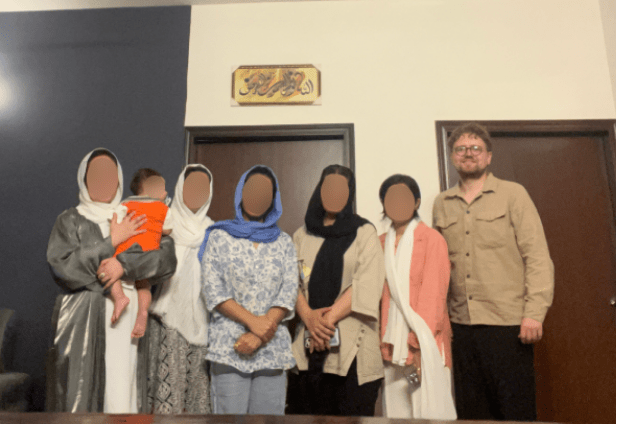
“I vowed to myself that I would fight until I died. Even if I was left alone, I would not silence my voice.”
Afghanistan is a country renowned for its hospitality, food, and culture. However, lingering above these celebrated stereotypes is a dark and brooding cloud of historical conflict.
Known simply, and somewhat accurately, as the graveyard of empires, Afghanistan’s history is soaked in blood. From the Persian Empire to the British, and now the Taliban, Afghanistan has been governed ruthlessly by outside forces for the better part of two thousand years. Among these conflicts, unimaginable horrors have been forced upon the Afghan people.
Today, under Taliban rule, these horrors continue to emerge, as there seems to be no end to the depraved treatment of the Afghan people.
It is stated in the Universal Declaration of Human Rights that “No one shall be subjected to torture or to cruel, inhuman or degrading treatment or punishment.”
Yet, inside countries and territories across the world, the practice of torture is continuing. In a global report (2023), 114 countries had reports of torture. One such country is occupied Afghanistan; the long-standing reputation of the Taliban’s brutal, oppressive, authoritarian theocracy is well documented.
The Taliban’s disregard for human rights has been noted by the Human Rights Index, which ranked Afghanistan second lowest on the planet — ranked only 0.02 above North Korea, with an overall score of 0.04 out of 1.
Rawadari, an Afghan human rights organisation, has announced that “numerous reports have emerged of widespread human rights violations, particularly in detention facilities under their control. In the absence of independent oversight bodies and effective legal deterrents, the Taliban, de facto authorities in Afghanistan (DFA), have arbitrarily and unlawfully detained individuals during this period, subjecting them to torture and ill-treatment.”
Darya, whose dream was to be a teacher and help disadvantaged girls following her studies, was arrested by the Taliban after attending and demonstrating at a protest in Kabul in 2022. The protest was in favour of women’s education and against the inhuman treatment of her fellow Afghans.
Only days after the protest, Darya and her family were imprisoned by the Taliban, tortured, and humiliated.
“It was near nightfall. Our house was surrounded, and the Taliban broke down our door and entered our house.
“I spent a week in a cold prison without food. When they were interrogating me, they tortured my father in front of my eyes until I confessed to a crime. I was released after 15 days.
“They beat us and cut off our hair to humiliate us.
“When my brother was tortured, he told me that they used electric cables on the soles of his feet.
“I continued and vowed to myself that I would fight until I died. Even if I was left alone, I would not silence my voice.”
Darya’s brother was arrested on the grounds that he participated in a protest in 2023. He was released after a week of torture and interrogation. He has since been imprisoned; his whereabouts are currently unknown.
The Taliban have requested the family pay $3,000 (US) for their son’s release, which, according to World Data, is roughly a year’s salary for an average Afghan family — which Darya’s is not.
“We already paid about twenty thousand Afghanis, some food supplies, and two sheep — that was only enough for them to set his prison term, not to release him.”
Although it is unclear the exact date on which the Taliban banned protests, the reputation of their treatment towards women and anyone who decides to speak out against them is often one of fear.
“They warned my father again that either we cooperate with the Taliban, or we will force your daughter to marry off to Taliban members.”
In interviews conducted by the UN, “individuals recounted beatings with pipes, cables, verbal threats, and abuse at the hands of de facto security force members.”
The threat of forced marriage and, in turn, forced sexual abuse and rape is a common theme within Taliban rule.
In a Rawadari interview, an Afghan national said, “They would strip me naked, pour water on my body, one person would sit on my legs, and another would hold my head tightly. They would beat me so severely I would beg, ‘God, just death, I want death every moment.’ Sometimes they would take off my clothes and hit my back with a chain tipped with thorns that would tear my skin. Each blow would cause blood to gush, and I’d lose consciousness. Three or four times when I resisted, they tortured me with that same chain.”
Another recites, “When I said I wasn’t a spy and had protested for my rights, they started beating me. They handcuffed my hands, repeatedly poured cold water on me, and beat me until I lost consciousness. I saw no mercy in them. Each time, they kicked my stomach so hard I passed out. They never considered that these blows could kill me. They would beat and torture prisoners every night.”
The victims of Taliban torture vary from peaceful protesters, ethnic minorities, homosexuals, and religious minorities. Due to information being limited from within Afghanistan, there is little indication of the true scale of this horrific practice.
The Taliban’s excuse for these imprisonments is “rebellion”—that those imprisoned are being paid by humanitarian charities and organisations to overthrow their internationally unrecognised governance and promote rebellion within their borders.
“Because I am a protester, the Taliban accuse us of being a ‘resistance’ or ‘rebellious’ family, claiming that we receive money through human rights work and use it to incite rebellion against them,” Darya continues.
Razia, an Afghan refugee in Pakistan, women’s rights activist, and talented sports enthusiast whose progression was halted by the Taliban decree of “no women in sports”, explained what would happen to those discovered following a Taliban arrest.
“If he [her trainer] was arrested, he would have been tortured and killed. Anything that would happen to us would also happen to him because he was supporting a girl, a woman.”
Farida worked in finance; she had just finished her studies at university and was looking to continue her education at a masters level. However, this was interrupted by the 2021 Taliban takeover. She was quickly thrown into a world of restrictions and oppression, but she fought.
Farida was arrested at a protest in Kabul. The Taliban bound her and imprisoned her without trial. She was tortured and humiliated by the Taliban for days.
“The torture I endured wasn’t just inflicted on my body,” Farida began, “it carved deep wounds into my spirit, my dignity, and my sense of being human. I was tortured excessively, to the point where I lost all sense of time, of day and night. Every moment was filled with humiliation, verbal abuse, psychological torment, and physical pain, blended together in a way that stripped me of my very humanity.
“I do not say this to seek pity, but to get justice, to speak the truth aloud. What happened to me must be known—must be heard—so that no other human being will ever have to endure such agony again.”
Sexual assault is another element of how the Taliban impose their power upon their prisoners. The mass rape of Hazara people and their liquidation into the Pashtun population is an ongoing humanitarian crisis. However, Hazaras are not the only minorities or peoples struggling with this horrific form of oppression.
“If the Taliban knew about them [Buddhists], they would imprison them, torture them, and kill them. The ones who are homosexual, they would be tortured and killed.” – Darya
The stigma of those arrested by the Taliban is a potent poison in Afghanistan. Those that are arrested often find themselves unsupported by their families or partners.
Razia recalls how she was treated following her arrest: “It is something normal, our society does not support us, neither do our families. They didn’t want to support us.”
“The Taliban are a terrorist group, but our families are another kind of Talib. They never help us and even beat us. We have never been supported by anyone. We are trying to fight this, so the next generation will not suffer these things.”
“Unfortunately, this bitter reality exists in our society. In a deeply traditional and male-dominated culture, even if a girl is innocent, being arrested often brings judgment and suspicion. People immediately assume that she has been abused or that the family’s honour has been damaged, even without knowing the truth.
Because of this, families often isolate or reject the girl to ‘protect’ their so-called reputation. This social stigma becomes a separate form of torture. Many girls become victims a second time — this time by their own community after being released from Taliban custody.
“Families often respond with suspicion and blame instead of supporting their daughters. They assume that if a girl is arrested, the family’s honour has been tarnished and that she has been abused. This misguided thinking causes innocent girls to be rejected and blamed instead of being supported.”
Upon investigation, there are clear signs of sexual abuse from the Taliban onto women imprisoned for their so-called ‘immorality’ in accordance with their warped version of Sharia Law and Islamic teachings. All the while, Afghan society — one that values family honour and integrity — causes the victims of these assaults to be deemed perpetrators of the crime.
Dr. Farkhondeh Akbari, a women’s rights activist and UN representative, remarked how misogyny and degradation of women’s rights in Afghanistan is being “localised and normalised in everyday society.”
“Young women are targeted not only by the Taliban but also by their family members. Fathers, sons, and older women of the family — mothers and grandmothers — are applying pressure to the younger women to conform. They have taken away the agency of being a woman. This is taking a big toll on Afghan women.
“Even in our own homes, even the relationship between a sister and a brother is being impacted. Their relationship has been changed because of the gender apartheid policy.
“Just the other day I was speaking to a woman who said she now has to rely on her fourteen-year-old son to take her to the bazaar because she is unable to leave the house without a male escort.”
“This can be reflected in the rise in female suicides in Afghanistan, especially in younger women.
Although it is currently impossible to fully understand the scale of suicide in Afghanistan due to the Taliban’s lack of international cooperation, videos online have surfaced from within Afghan borders of women protesting forced marriages by performing self-immolation.
Darya remarks on this issue by stating how: “In Ghor, a girl who escaped a forced marriage set herself on fire. Sadly, these are just a few examples among many untold tragedies.”
In 2023, Dr. Shikib Ahmadi, a pseudonymous doctor at a mental health clinic in Afghanistan, told CNN that “the number of female patients has surged 40% to 50% since the Taliban took over in 2021, and about 10% of them take their own lives.”

 Uncharted Thoughts.
Leave a comment