“They are afraid of our power”
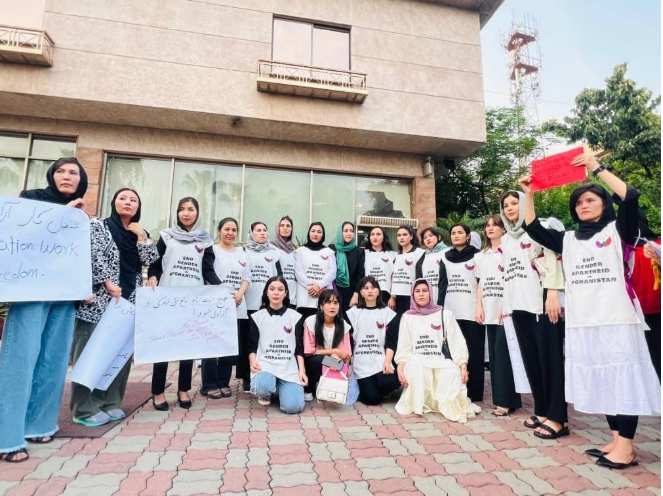
Women activist groups across the world have joined together in solidarity to combat the ongoing oppression of their gender in Afghanistan.
Since the United States left Afghanistan in August 2021, the largely internationally condemned, tyrannical theocratic government known as the Taliban has continued to oppress its citizens under a corrupted form of Islamic Sharia law.
While all genders, sexualities, and minorities have been affected by these changes in government policy, women stand at the forefront of these restrictions.
According to RAWA News, an independent outlet reporting on atrocities in Afghanistan, the following restrictions have been implemented since the Taliban takeover in 2021: the right to protest has been annulled; the right to hold government office has been suspended for women; girls are now banned from attending high school, extending into university education; music and art are prohibited; segregation of women and men in public spaces is enforced; women are banned from appearing on television; travel restrictions are in place for women; female drivers are banned; women’s participation in sports is forbidden; interaction between female students and male staff is restricted; women are no longer allowed to work; public images of women have been removed; the hijab has been imposed; and additional restrictions are enforced by the new police force tasked with upholding ‘Virtue and the Prevention of Vice.’
UN investigators have reported that “Afghanistan’s Taliban rulers have ‘weaponized’ the legal and judicial system to oppress women and girls in what amounts to crimes against humanity.”
The UK government has recognized these restrictions and stated that “the Taliban have gradually restricted women’s social and political rights and limited the areas of public life in which they can engage. Women and girls are subject to widespread and systematic discrimination, which in general amounts to persecution.”
Amid internationally condemned mass deportations from Pakistan and Iran, Afghan refugees have come together to protest the Taliban as it marks its fourth anniversary in power.
The Afghan Women’s Justice Movement hosted heartfelt speeches of freedom, struggle, and the condemnation of the Taliban from an undisclosed location in Islamabad.
Seven women dressed as those who conducted the Doha Agreement took to the stage, their faces covered by paper visages of the Taliban’s Abdul Ghani Baradar, U.S. foreign policy expert Zalmay Khalilzad, and the Qatari mediators.
The play hinted at the corruption of the American government, with backhanded deals expressed through secret exchanges of black bags. Upon the American actress leaving the stage, the Taliban actresses began a display of beating a fellow Afghan refugee—forcing her to wear a burqa while flogging her with mock whips.
Before long, more girls joined the one being beaten. They chanted in unison, their hands punching the air: “Say no to violence, no to Taliban, end gender apartheid.”
Afghan refugee and women’s rights activist Elahah took to the stage, and in a powerful speech encapsulated the plight of women in Afghanistan. She said:
“We remember those who have been imprisoned, tortured, or lost their lives for daring to dream of equality. And we reaffirm that the struggle will not end until Afghanistan is free, until the voices of women are not just heard, but respected, and until no one lives in fear. Our message is clear: the Taliban may control the land, but they will never control the spirit of Afghan women.”
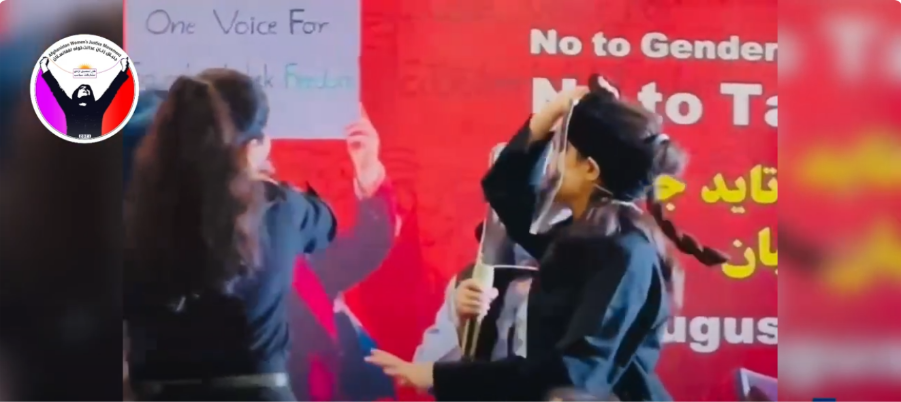
Nadia, a founder and spokesperson for the Afghan Women’s Justice Movement, addressed the protest with a heartfelt speech:
“Women have filled the streets with their voices, demanding freedom, education, and the right to live with dignity. They have faced arrests, beatings, threats, and exile, yet they continue to stand. Their resistance is not only for themselves, but for every child, every family, and every future generation of Afghanistan.”
“On this day, we remember those who have been imprisoned, tortured, or lost their lives for daring to dream of equality. And we reaffirm that the struggle will not end until Afghanistan is free—until the voices of women are not just heard, but respected, and until no one lives in fear.”
“Our message is clear: The Taliban may control the land, but they will never control the spirit of Afghan women.”

An investigation into the treatment of minorities conducted by the U.K. government in 2023 noted how:
“Over the past three years, since their takeover of Afghanistan, the de facto authorities have subjected Afghan women and girls to more than 70 edicts, directives, and decrees stripping them of fundamental rights.”
One refugee recalled how the Taliban were “treating us worse than animals” and how they “do not think of women’s wants, only their own needs.”
Farida, a board member for the activist group Women’s Freedom Light Movement, highlights:
“No matter where I am in the world, I would continue this work, because I have suffered so much at the hands of the Taliban.
Before the Taliban, I was happy doing my job, continuing my education, and trying to get my master’s degree. But once the Taliban came, everything fell down. I couldn’t do my work. I was an independent woman, but after they came, we were forced to flee to Pakistan to save our lives.”
“The Taliban are arresting the ladies, unmarried girls, and they are wanting to have their ways with them. Once I was near to my home, they were asking me, ‘Where is your man?’ Every female needs to have a man with her—‘Where is your man, your brother, your father, your husband?’ She told them, ‘My home is near to here, speak to my brother.’”
“If my brother wasn’t there, they would have forced me to marry someone, and take me for themselves.”
Forced marriages are common throughout Afghanistan. With or without the Taliban, this practice has persisted for generations. However, according to interviews conducted for this article, there has been a rise in forced, underage marriages throughout Afghanistan since the Taliban’s return. This is largely due to economic pressures created by poor governance.
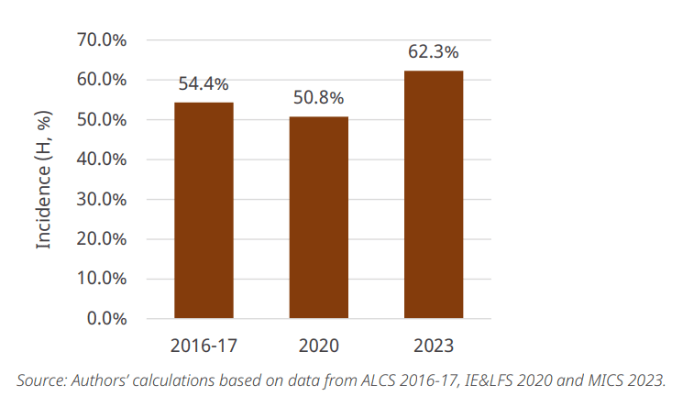
Under Taliban rule, Afghanistan has once again become a poverty-stricken country. According to a UNICEF investigation, there has been a “rapid rise in multidimensional poverty, from 50.8% in 2020 to 62.3% in 2023.”
Due to restrictions on information and limited access to the country, statistics on child marriage are unavailable. However, UNICEF implores the Afghan government to tackle this issue, stating they are “deeply concerned by reports that child marriage in Afghanistan is on the rise” and that “the future of an entire generation is at stake.”
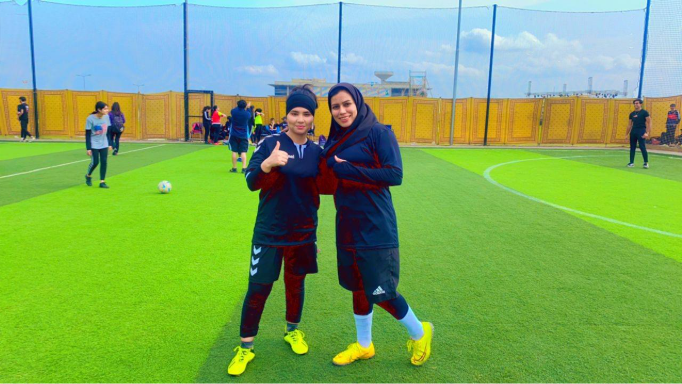
Arezo was a national football player before the Taliban’s re-emergence. She proudly played for the Afghan women’s national football team, both nationally and abroad, travelling to India and Sri Lanka to play for her beloved country.
“Football was my first and last love,” she remarked. “From the moment I knew this is my left hand and this is my right, from that time I loved football.”
“I played football with the boys. While girls were playing with dolls, I was not like [them]; I loved to have my own ball and play.”
“My father encouraged me. When I played in India, he told me, ‘You are not just Arezo, your team is not just a team—you are ambassadors of Afghanistan. You can show the world how powerful we are.’”
Arezo was eighteen when the Taliban banned women’s participation in sport, along with all the other restrictions placed on women. Arezo’s dreams to be a footballer and represent Afghanistan on the world stage were crushed—along with any possibility of her independence and sense of freedom.
“When the Taliban banned sports for us, I was heartbroken. Even mentioning football was considered a crime for girls.”
The right to protest in Afghanistan has been revoked for women, and the punishment for insubordination is imprisonment without trial or hearing.
Almost every woman I interviewed while in Pakistan had been detained by the Taliban for protesting in Kabul in 2023.
Each holds different stories of their imprisonment. All were neglected and/or tortured by the Taliban.
Nadia recalls her imprisonment:
“Siblings and I were arrested by the Taliban, [at] around six PM from our house in Kabul-Dashat-e-Barchi. The Taliban tortured us very badly when we were in prison. Almost the whole time that we were there, there was no time without torture, because of our protests, because of our gender, and because of our ethnicity.”
The punishment of a woman’s disobedience extends beyond her own imprisonment and torture. The Taliban also impose beatings, imprisonment, and murder onto their families.
Nadia continues:
“On December 4th, 2021, the Taliban shoot my brother in front of their police station. His foot was injured, it happened when he was coming back from [the] restaurant that he was working [at]. He got shoot due to [the fact he] didn’t prevent us from protest[ing] against them, just to send us this message that we should stop otherwise they will do anything.”
UN Article 2 of the Convention against Torture and Other Cruel, Inhuman or Degrading Treatment or Punishment states:
‘No exceptional circumstances whatsoever, whether a state of war or a threat of war, internal political instability or any other public emergency, may be invoked as a justification of torture.’
So, are the Taliban just enforcing the Quran in its rawest form? Practicing Islam how it was intended by their Prophet Muhammad? Or are they a stain on the name of Islam?
Saleha Islam, a British Muslim Chaplain, said:
“While I am an Islamic scholar, I should clarify that I do not have direct expertise in the political dynamics of Afghanistan.”
“The Qur’an strongly encourages the pursuit of knowledge for both men and women. The very first revelation of the Quran begins with the command ‘Read’. The Prophet Muhammad (peace be upon him) also said, ‘Seeking knowledge is an obligation upon every Muslim.’ There is no basis in Islamic scripture to prohibit female education; on the contrary, it is upheld as a right and duty.”
On the subject of child marriage, Saleha said:
“The Quran emphasises that marriage should be entered into with mutual consent and that both parties should have reached a level of rushd, i.e. maturity and sound judgment (Surah An-Nisa 4:6). While historical Islamic jurisprudence permitted marriage upon physical maturity—which, in many societies of the past, was associated with puberty—it’s important to understand that concepts of emotional and psychological maturity were perceived differently in those contexts. Life expectancy, social roles, and responsibilities all began at much earlier ages than what we are accustomed to today.
“In contrast, many contemporary Muslim scholars now emphasize that true maturity must include emotional, psychological, and legal readiness. With modern understandings of child development and well-being, there is growing consensus that early marriage can have harmful consequences and contradicts the Quranic principles of compassion, justice, and safeguarding individuals from harm.”
“What do you think the Taliban are afraid of, why do you think they are persecuting women?” I asked.
“It is because they are afraid of our power,” Bakhtawar responded with determination. “They are afraid of change and that their ways will be changed.”
To escape this gender persecution, women are fleeing their homelands in search of a better life. However, some women are unable to make this sacrifice. Some women are stuck in the heart of Afghanistan—forced to wear the burqa, forced to be silent and uneducated, forced to bear childbirth in poor conditions, forced to live a life of oppression. These women seek their freedom through suicide.
Darya, a member of the Afghan Women’s Justice Movement, recalls how:
“In Panjshir, a girl whose family tried to force her to marry a Taliban member attempted self-immolation. The first time she survived, the second she did not.
“And in Ghor, a girl who escaped a forced marriage set herself on fire. Sadly these are just a few examples among many untold tragedies ”
These are the lengths to which women are going for freedom from their oppressors, in this fight for equality across Afghanistan.

 Uncharted Thoughts.
Leave a comment