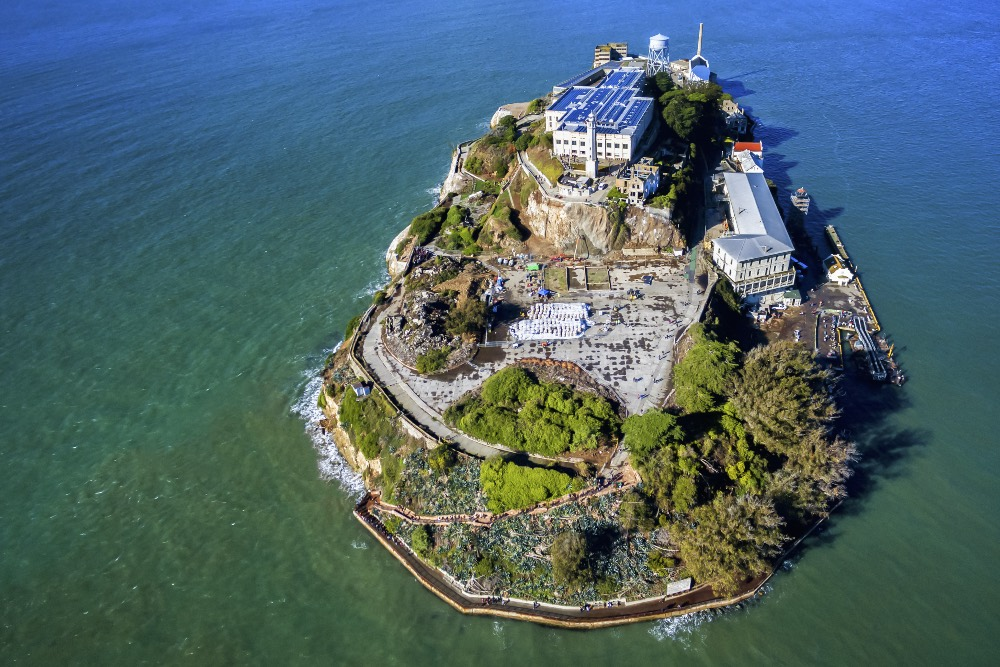
On the 20th of November 1969, a group of indigenous peoples, recognised formally as “The Indians of all tribes” took control of the infamous prison island of Alcatraz in the San Francisco Bay area. An occupation that lasted nineteen months and sparked a revolutionary movement of ‘Red Power’ across the United States of America.
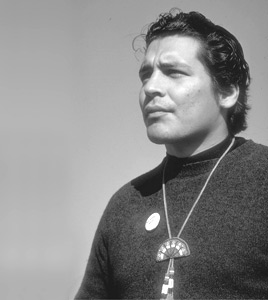
A tale of bravery, righteousness and community that has been long forgotten in recent years under the weight of the black American civil right experience. Heavy hitters such as Martin Luther King Jr, Malcom X, Ella Baker and Rosa Parks often take the limelight over indigenous leaders such as Denis Banks, LaNada War-Jack (Means), Richard Oaks, John Trudell and Clyde Bellecourt.
The occupation of Alcatraz was a central, defining moment for the Indigenous Civil Rights movement. Although there had been some organisations formed prior to this monumentous moment, such as American Indian Movement (AIM) and the National Indian Youth Movement (NIYC) there was no real traction made until the 20th of November 1969.
Alcatraz was the spark that lit the flame of demonstrations. Following the 20th of November 1969 a roar of support formed and other protests were carried out by the new ‘red power’ movement. For example, the occupation of Mount Rushmore, The Wounded Knee occupation and the longest walk. All of which were inspired by the occupation of Alcatraz island.
500+ broken treaties.
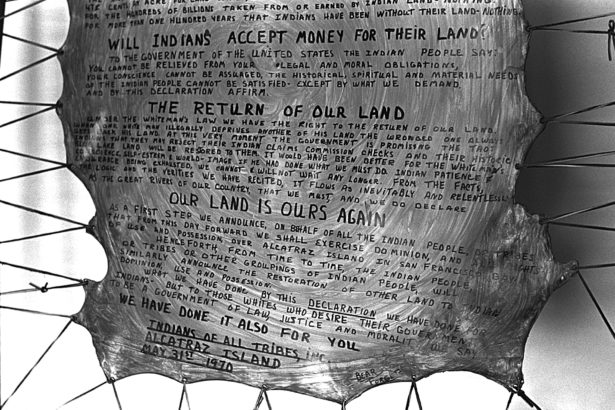
It is well documented that the treaties of the U.S. government offered to the indigenous peoples of the Americans were, from the outset, nothing more than ink and paper. Each year that passed, another treaty was broken and with it any hopes of indigenous independence, as the growing, pulsing American machine of industry grew west.
In 1968 however, the Fort Laramie treaty of 1868 was rediscovered and became a weapon for the indigenous peoples to use against the U.S. government, now lead by Richard Nixon. The treaty was an agreement made by the U.S to provide the ‘Indian’ population with any unused land required by the U.S following five years of its abandonment.
Alcatraz was shut down in 1963 and by 1969 was used only as a lighthouse for passing ships. This discovery was the key to taking Alcatraz lawfully. The Indians of all tribes (IOAT) had Nixon and the history of the United States against the ropes. If they are to honour the agreement of the treaty and let the IOAT stay on Alcatraz, they would not only be allowing the indigenous peoples a HQ for their newly found power, but also accept that the treaties are still a legal document and therefore, all the land possessed by the states should be returned to those it once belonged to. If Nixon denies that the treaty has any credibility, it will cement the already clear hypocrisy of the treaties and spark another Civil Rights movement. President Nixon decided to take the latter route.
Life on the island.
According to sources collected at the 52nd anniversary of the occupation in 2021, life on the island for those nineteen months was difficult and at times dangerous. With water shortages, crumbling buildings, extreme weather conditions, internal and external conflict, a suspicious fire, a shipwreck and the tragic death of a child, Alcatraz was a battle within a battle.
Between the 20th of November 1969 and the 10th of June 1971, there is very little known regarding life on the island. There was clear intentions to create a legitimate community, as the IOAT had formed a hospital of sorts, created a radio room for broadcasting, living quarters for hundreds of people, a kitchen and even a school for the children.
The dream was becoming a reality, but for some, it was not coming soon enough. Occupiers soon became impatient and internal conflict began. There were reports of violent outrage, leadership squabbles, sexual assault and child abuse. Whether these allegations were a ploy by the government leaked into the press, racist stereotype rumours spread by those against the occupation or legitimate news is unclear. Whatever the truth, life on the island was hard. Water was often sparse, medical supplies low, appropriate clothing few and far between.
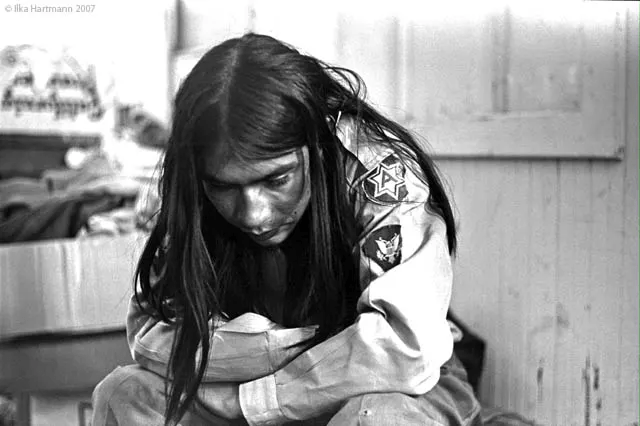
Photo taken by Ilka Hartman, a incredible German photographer
The close of the occupation.
By June 10th, 1971 the occupation was brought to a close. Federal officers removed the remaining 15 individuals. The plan to make the island into a heaven of education for indigenous peoples was gone and with it, a dream for justice. The plan had been to establish a ‘great Indian training school’, a ‘centre for native American studies’, ‘an American Indian spiritual centre’, ‘an Indian centre of ecology’ and ‘American Indian Museum’ in an attempt to re-establish their culture and set history straight.
To look at this occupation at face value, it is a clear failure. The island was never established as native land, the planned established institutes were nothing more than a fantasy and internal fighting had separated a large majority of participants into secular groups, some of which were more violent than the peaceful tones of the IOAT. Yet, this was a pistol crack at the starting line of the indigenous civil rights movement. Without it, there would have been no movement towards a more equal America.
 Uncharted Thoughts.
Leave a comment