Where to begin?
Ever since I can remember, my life ambition has been to create, tell and live in vibrant and exciting stories. Which is, in some regard rather ironic as a dyslexic. Writing, reading and feeling stories has been a life long passion, one that I have been unable to itch.
It is not the destination of the story that fascinates me so much, rather it is the journey, the characters met along the way and the trials put in front of the protagonist(s). I have led an extraordinary life, especially for someone so young. Born in May 1995, now a five foot ten male with more experience than most, the itch has still yet to be scratched.
When I was a boy, fantasy stories captivated me, filled me with wonder and joy. To read about Harry Potters journey through Hogwarts was mind altering. It made me realise that words can change reality, the perspective of what is real, to change our very hearts and minds. Simply put, with the correct ordering of letters, a mind can go from the mundane realities of our every day life, to delving into the world of magic.
Before Harry Potter, there was a collection of stories my mother would read to me. The name of the book escapes me, but the stories do not. A printed cover of a pirate ship run-a-shore on a tropical island filled my mind with wonderous ideas of buried treasure, hostile tribes and life without the technological advances of todays society.
But it was always one story, that grabbed my attention more so than the rest. Two or three times a week, my mother would sit at my bedside, pick up this book of wonders and read to me. Three quarters of the time, I’d request the story of the Yeti.
The story was simple, five men went exploring in the Himalayan mountains. Upon reaching the upper canopy of the ancient mountains pass the group discover a large footprint. An old black and white photograph on the side of the page showed the magnitude of this mysterious being. After much discussion, the group decided to press on, to ignore the evidence of life and get to basecamp. It was not long however, until the master of these prints would made an appearance.
Blinded by the snow capped mountains, the blazing sun and strong winds, in the distance a large figure was spotted. Here, in the inhospitable land of the worlds spine, walking on two legs, a gigantic creature roamed free, and naked. Another black and white photograph of this white mysterious being filled my imagination with wonder.
This, is something worth my time.
Although I was young and yet to understand the world. I knew that story telling was my journey. As I grew, I read. As I read I became more aware that the world of Hogwarts, Middle Earth, Westeros and Arrakis were just reflections of our own world. That the tales of magic, adventure and the battle between good and evil were just as alive in Earth as they were on these fantasy pages. If not more so.
While in my second year of university, I pondered over my dissertation. I considered venturing into geo-political history, studying African politics. Examining the wars and political turmoil in the early and late 90s. Trying to find a subject I was both passionate and intrigued about. That’s when I stumbled across Sierra Leone. I became obsessed with the civil war, the stories told my survivors and the impact this horrific genocidal act had upon the people, the land and its legacy.
I spent long days read biographies of child soldiers. I was getting closer to my dissertation, I could feel it. I attempted to contact with old members of the rebel groups, politicians and charities. Anyone that would respond was a step closer to the story I wished to tell. Then, I took my first Oral History class, lead my Dr Darren Aoki. Here I discovered the theme of my dissertation, oral testimonies.
It was a discovery like no other, I could combine the use of historical research, interviews, journalism and story telling to produce a piece I would be proud of.
But what was my subject matter?
Well, Sierra Leone was becoming a dead end. I was struggling to find anyone to interview. The process was slow and although I was engaged in the overall conflict and those involved, there was no real momentum behind the project. So later that year, while learning about the civil rights movement in the United States an idea sprung from the depths of my imagination.
My father, like his before him, is fascinated by indigenous American culture and history. My house growing up was filled with cross stitches of tepees and American sunsets. A bone peace-pipe hung on the wall of my dining room, old books on the frontiersmen and cowboys lined the shelves. Dinner table conversations often drifted towards the American West. Why don’t I look at indigenous civil rights? I was supposed to be out there this year anyway, but COVID decided it was time to tear that dream from me.
So I got to work. It wasn’t long before I discovered the “Indians of all Tribes” movement. A civil rights movement that shook the foundations of America. Let me explain;
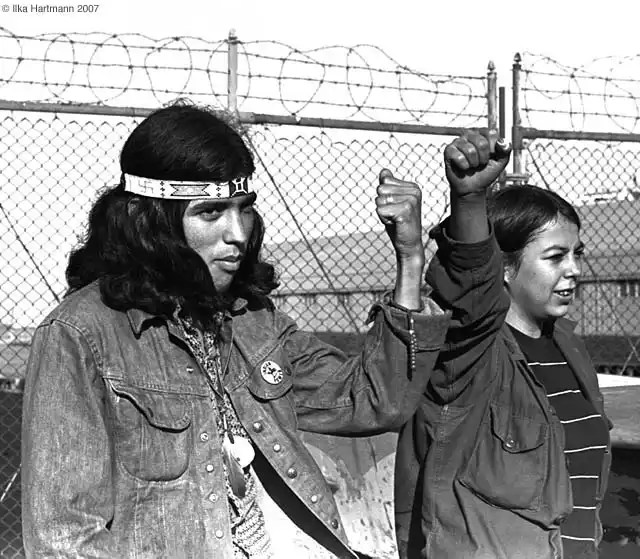
In 1969, a group of indigenous Americans under the banner of “Indians of all Tribes” floated out to Alcatraz Island, seized it, without any violence, and occupied it for nineteen months. Through power cuts, starvation, death and turmoil the group was determined to settle and flourish there. Although I could go on and on about the occupations historical context and future influence, I will not this time around.
So, I emailed, found a photographer names Ilka Hartmann and set up an interview. It wasn’t long before she called and told me that the occupation was to have a anniversary that November, so I flew out to the US and interviewed three members of the tribe and collected as much date and primary sources as possible before heading home.
It was sat across from LaNada War Jack, one of the three leaders of the IAT and realised that this was my calling. That this was worth my time.
 Uncharted Thoughts.
Leave a comment